

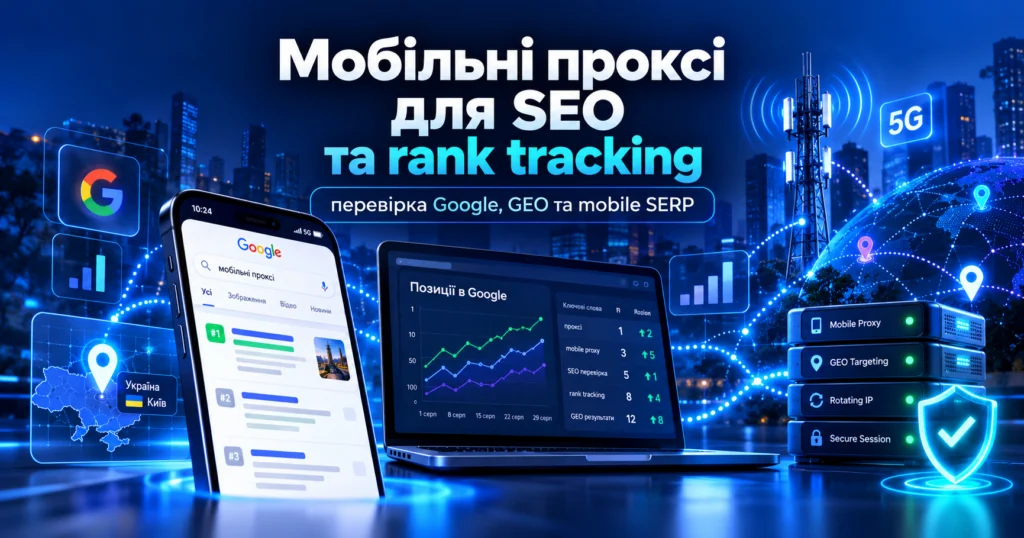
SEO analytics depends on accuracy. If Google rankings, local search results, or mobile SERPs are checked from the wrong IP, country, device, or an unstable network environment, the resulting data can quickly become noisy. This is why mobile proxies are increasingly used for rank tracking, SERP monitoring, GEO checks, and technical SEO.
A mobile proxy provides an IP address from a real mobile carrier network. For SEO, this matters because Google may show different results depending on the country, city, device type, language, session history, network, and behavioral signals. If a business targets a specific region, checking search results from just any IP is no longer enough.
In this guide, we will explain when mobile proxies are useful for SEO, how they help with rank tracking, which settings matter, how frequent IP rotation can affect data consistency, and what to check before choosing a proxy.
What Are Mobile Proxies in SEO?
Mobile proxies route traffic through IP addresses assigned by mobile carriers. Instead of appearing as a datacenter connection or home Wi-Fi network, the SEO tool connects through a mobile network such as 4G, LTE, or 5G.
For SEO, this is useful when you need to view Google under conditions closer to those of a real mobile user:
- checking rankings in local search results;
- mobile SERP tracking;
- monitoring competitors across different GEOs;
- checking snippets, titles, and meta descriptions;
- analyzing People Also Ask, related searches, and local SERP features;
- testing mobile landing pages;
- checking redirects, hreflang, and regional site versions;
- QA for ads, UTM parameters, and landing pages;
- working with SEO tools that require stable IP connections.
The main value of a mobile proxy for SEO is not anonymity for its own sake, but control over the conditions in which the search results are checked.
Why a Regular Ranking Check Is Often Not Enough
SEO specialists often see different rankings for the same query. This is normal because Google personalizes and localizes results. Even when personalization is minimized, search results may still be influenced by:
- IP country;
- city or region;
- browser language;
- device type;
- mobile or desktop SERP;
- search history;
- cookies;
- Google datacenter;
- carrier or ASN;
- request frequency from the same IP.
Because of this, an “average” ranking does not always reflect what a real user sees. A site may rank highly from a desktop IP in Kyiv but lower in the mobile SERP from another region. An English-language page may also perform well while the Ukrainian version performs worse because of a weaker intent match.
Mobile proxies make it easier to test these scenarios under controlled conditions.
SEO Tasks Where Mobile Proxies Are Useful
Google Rank Tracking
Rank tracking is the regular monitoring of website positions for target keywords. If rankings are checked from a single unstable or irrelevant IP, some of the resulting data may be inaccurate.
Mobile proxies can help you:
- check rankings from the required country;
- view mobile search results closer to the experience of a real user;
- reduce the risk of restrictions during repeated checks;
- separate projects across different IPs;
- compare results between regions.
For MSOCKS, this is particularly relevant for projects targeting Ukraine that need to verify Google results through Ukrainian mobile carrier networks.
Local SERP Tracking
Local search results may vary significantly even within the same country. For businesses tied to a particular region, it is important to see not an abstract version of Google but the results a potential customer is likely to encounter.
A mobile proxy can be useful for:
- local SEO;
- service businesses;
- e-commerce with regional delivery conditions;
- sites with multiple language or regional versions;
- checking Google Business Profile results;
- monitoring local competitors.
If users search for a service from their phones, a desktop check from a datacenter IP may provide an incomplete picture.
Mobile-First SEO
Google has long evaluated websites with a mobile-first approach, and many commercial queries receive a significant share of mobile traffic. SEO specialists therefore need to check not only the ranking itself, but also how the page appears in mobile search results.
Using mobile proxies, you can check:
- whether mobile SERPs differ from desktop SERPs;
- whether titles and descriptions are displayed correctly;
- whether PAA, video, local pack, or shopping blocks appear;
- whether regional redirects are triggered;
- whether language versions work correctly;
- whether content changes across GEOs.
This is especially important in niches where users make decisions quickly, including delivery, repair services, healthcare, financial services, e-commerce, SaaS, and local services.
Mobile, Residential, or Datacenter Proxies for SEO
Different proxy types can be used for SEO, but they provide different network characteristics.
Datacenter Proxies
Datacenter proxies are usually fast and less expensive, but they are easier to identify as non-consumer network traffic. They may work for basic technical checks, but regular SERP tracking can result in more CAPTCHAs or temporary restrictions.
Residential Proxies
Residential proxies use IP addresses associated with household ISP connections. They are useful for broad GEO testing and many research tasks. However, when the goal is to test a mobile SERP or a smartphone-user scenario, a residential IP may not reproduce the same network context.
Mobile Proxies
Mobile proxies are best suited to tasks where the mobile carrier, 4G/5G environment, stable session, and mobile-first context matter. They are particularly useful for local SEO, rank tracking, ad checks, SMM projects, and mobile SERP testing.
Sticky Sessions or Rotation for Rank Tracking
One common mistake in SEO monitoring is changing the IP too frequently. Rotation can be useful, but it is not always the right choice.
When to Use a Sticky Session
A sticky session is useful when you need to:
- check several queries within the same regional context;
- compare SERPs for a group of keywords;
- test local results without frequent IP changes;
- monitor ranking stability;
- work with an SEO tool that does not handle frequent IP changes well.
For rank tracking, stable conditions are often more important than the maximum possible number of IP addresses.
When IP Rotation Is Useful
Rotation can be useful when:
- you need to check a large number of keywords;
- temporary restrictions may occur;
- projects need to be separated;
- you need to compare results across different networks or regions;
- the tool performs regular automated requests.
The better approach is not random rotation, but controlled IP changes that follow the logic of the task.
How to Configure a Mobile Proxy for SEO Tools
Most SEO tools and custom scripts accept a standard proxy format:
host:port:username:password
Or separate fields:
- proxy host;
- proxy port;
- username;
- password;
- protocol: HTTP, HTTPS, or SOCKS5.
Before starting rank tracking:
- Choose the required GEO and carrier.
- Select the correct protocol.
- Add the username and password or configure an IP whitelist.
- Check the external IP address.
- Verify the country, ASN, and carrier.
- Run a small test set of keywords.
- Check for CAPTCHAs or unstable responses.
- Only then start the full rank-tracking process.
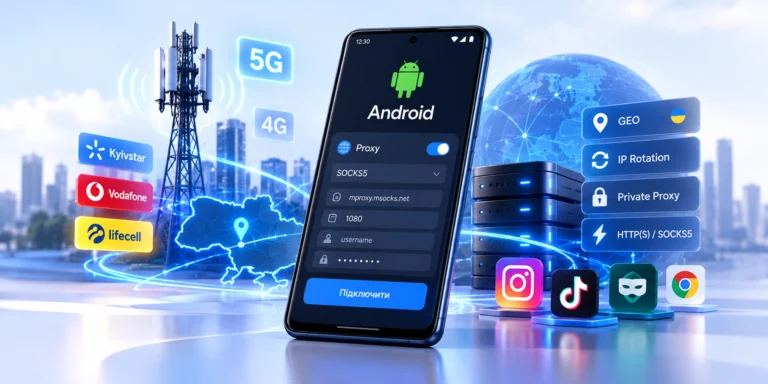
If the check is performed from an Android device, see the MSOCKS guide on setting up a mobile proxy on Android.
What to Check After Connecting
A successful proxy connection does not automatically mean that the proxy is suitable for SEO.
Check:
- whether the GEO matches the required country;
- whether the ASN belongs to the expected mobile carrier;
- whether Google opens consistently;
- whether persistent CAPTCHAs appear;
- whether the IP remains stable during one session;
- whether response speed is sufficient;
- whether the language of the SERP is correct;
- whether local pages open as expected;
- whether DNS or WebRTC leaks occur;
- whether the rotation URL works correctly.
For rank tracking, consistency and repeatability are just as important as raw speed.
Common SEO Proxy Mistakes
Checking All Keywords From One IP
If a large list of queries is checked from one IP without pauses or a clear request strategy, you may encounter CAPTCHAs, temporary restrictions, or unstable SERPs.
Changing the IP After Every Query
This is not always the right approach either. Local rank tracking benefits from preserving a consistent context. Excessive rotation can make the resulting data harder to compare.
Mixing Mobile and Desktop Results
Positions in mobile and desktop SERPs may differ. If both are mixed in one report, it becomes difficult to understand the actual trend.
Not Checking GEO and ASN
An IP may appear to belong to the correct country while actually originating from an unexpected network type. For mobile SEO, it is important to verify not only the country but also the carrier or ASN.
Trusting a Single Tool Without Manual Verification
A rank tracker can make mistakes. For important queries, it is useful to manually verify the SERP in a separate session with a clean browser and the correct GEO.
MSOCKS Mobile Proxies for SEO
MSOCKS is suitable for SEO teams that want to check Google through Ukrainian mobile IP addresses and control IP rotation.
For SEO and rank tracking, relevant capabilities include:
- Ukrainian GEO;
- Kyivstar, Vodafone, and lifecell mobile networks;
- HTTP(S) and SOCKS5/UDP;
- private access model;
- unlimited traffic;
- controlled IP changes;
- the ability to test the proxy before purchase;
- use in browsers, SEO tools, Android devices, or anti-detect environments.
Practical workflow:
SEO tool → MSOCKS mobile proxy → Google SERP → rankings, GEO, mobile results and competitor checks
This setup can provide a more controlled environment for local SEO, mobile search results, and regular rank monitoring.
FAQ
Do I Need Mobile Proxies for Rank Tracking?
Yes, when you need to check mobile or local search results, work with a specific GEO, reduce the risk of restrictions during repeated checks, and maintain more consistent conditions for regular monitoring.
Can I Check Rankings Without a Proxy?
Yes, but the results may be influenced by your real IP address, location, browser language, history, and device type. Professional rank tracking benefits from controlling these conditions.
Which Proxies Are Better for SEO: Mobile or Residential?
Residential proxies can work well for broad research and GEO testing. Mobile proxies are better suited to mobile SERP checks, local SEO, mobile carrier testing, and workflows where stable mobile sessions matter.
Do I Need IP Rotation for SEO?
Yes, but it should be controlled. A sticky session often works better for one group of keywords, while larger keyword lists or multiple GEOs may benefit from rotation.
Can a Proxy Affect Ranking Accuracy?
Yes. The IP, GEO, network type, and session stability can influence which version of the SERP an SEO tool or browser receives.
Can Mobile Proxies Be Used for Competitor Research?
Yes. They can help check how competitors appear in local and mobile search results, which snippets are displayed, which SERP features are present, and how results differ across regions.
Do I Need a Mobile Proxy for Google Search Console?
Usually not for working inside GSC itself. A mobile proxy can still be useful for manually checking SERPs, local results, mobile search output, and page QA.
Conclusion
Mobile proxies for SEO are a tool for controlling the conditions under which search data is collected. They help you check Google from a required GEO, view mobile SERPs, monitor rankings more accurately, test local pages, and analyze competitors under controlled network conditions.
For rank tracking, it is not enough to simply use any proxy. The protocol, GEO, session strategy, rotation, and IP verification all need to match the task. In SEO, accuracy is often more important than the number of requests.
If you need Ukrainian mobile IP addresses for Google rank tracking, local SERP checks, mobile SEO, or regular search monitoring, test MSOCKS in your real workflow before launching full-scale monitoring.